Risk Management and Monitoring Framework – PRISM
PRISM – Predictive Risk Intelligence System & Monitoring provides organizations with centralized capabilities to record, classify, analyze, and review risks by type, group, and severity

PRISM – Predictive Risk Intelligence System & Monitoring provides organizations with centralized capabilities to record, classify, analyze, and review risks by type, group, and severity

PRISM enables organizations to register cybersecurity and operational incidents, track corrective measures, monitor deadlines, and document decisions and their implementation.
Designed for organizations subject to DORA and NIS2 requirements or following ISO/IEC 27001, PRISM supports structured, auditable, and verifiable risk management processes. Latvian customers can also generate and print cyber incident reports in accordance with Cabinet of Ministers Regulation No. 397.
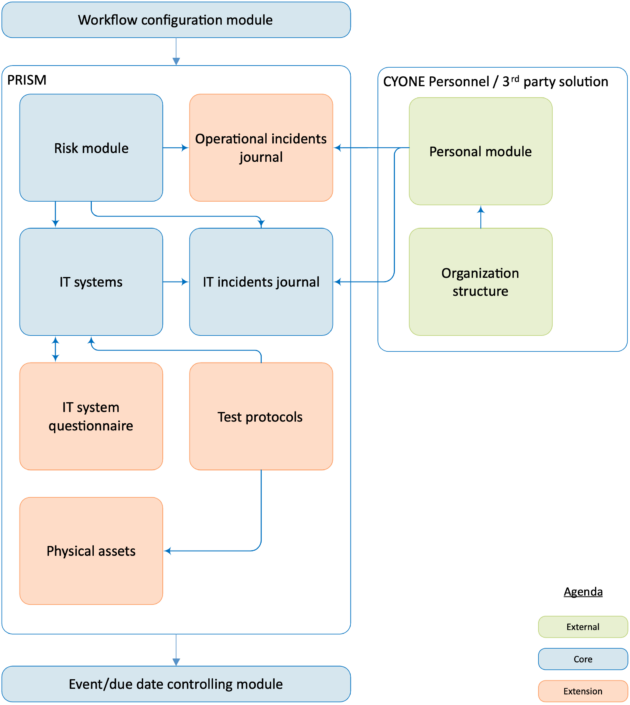
The PRISM Risk Module enables organizations to identify, assess, and manage ICT and operational risks in a structured, auditable environment. It provides configurable risk scoring, risk appetite monitoring, treatment planning, and automatic review scheduling, with risks linked to relevant IT systems and business functions. Complete version history and audit trails support transparency, accountability, and alignment with frameworks such as DORA, ISO 31000, and Basel III.
The level of risk is determined automatically according to the matrix:
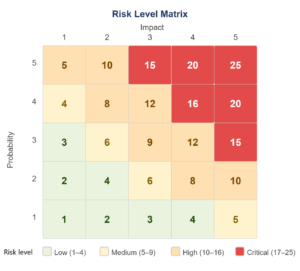
In this case, the risk level can be manually assigned above the automatic value. According to ISO 31000:2028 – Risk Management Guidelines.
The card of the risk is represented by large set of fields and configurable workflow on top of it.
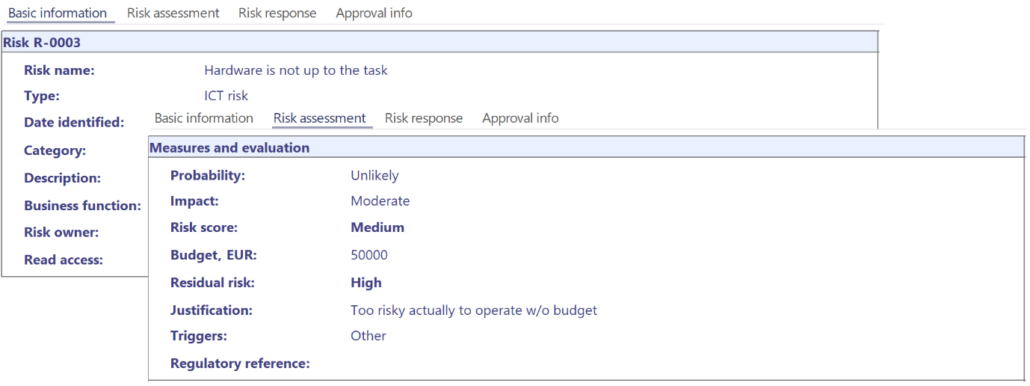
A decrease or increase in risk, as well as significant changes as a result of the review, are recorded when creating a new version of the risk card.
The PRISM Risk Approval Protocol enables risk managers to review, update, and approve multiple risks in a single workflow. Risk levels can be adjusted or obsolete risks deactivated, with every change supported by a documented justification. Each approved protocol provides a consolidated, auditable record of decisions and authorisations.
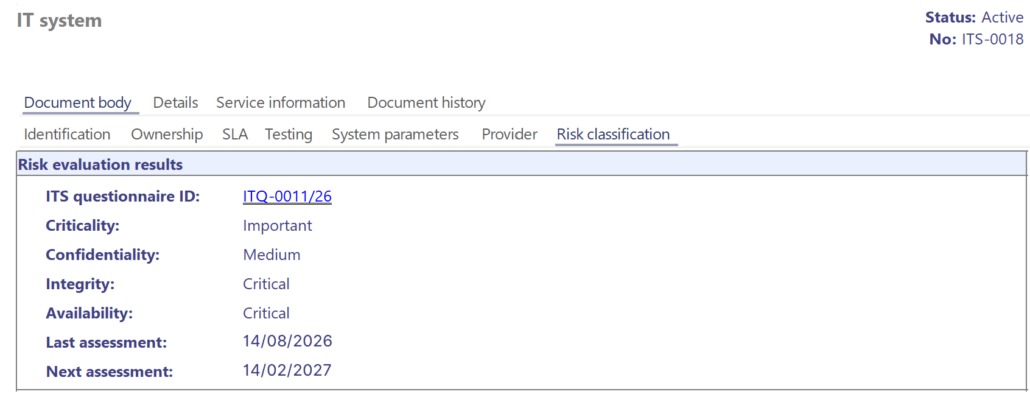
The PRISM IT Systems module provides a central register of organisational information systems, covering ownership, technical architecture, data classification, DORA criticality, and business continuity parameters such as RTO, RPO, and MTPD. It links system data to incident management and testing, supports SLA breach detection, and records third-party ICT providers to facilitate DORA compliance. The module can be used with minimal configuration, with optional questionnaires and test protocols available for more structured assessments and auditability.
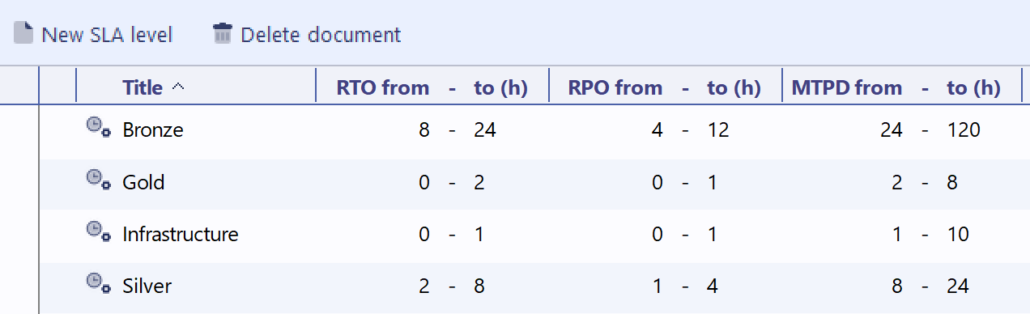
The module allows setting up SLA levels with ranges of parameters. These levels can be assigned to each IT system.
The module maintains a structured register of all ICT service provider contracts, capturing the key parameters required for third-party risk management under DORA Article 28. Each agreement records the vendor and provider details, contract type, criticality classification, validity period, and the responsible owner — ensuring that contract expiry dates and renewal obligations are tracked automatically and escalated through the Event module before they fall due.
The PRISM IT System Questionnaire guides system owners through risk identification, mitigation planning, and the assessment of Confidentiality, Integrity, Availability (CIA), and system criticality. Automated calculations based on standardised classifiers ensure consistent, auditable results, which are reviewed by the GRC team and integrated directly into the system card, keeping the asset register accurate and up to date.
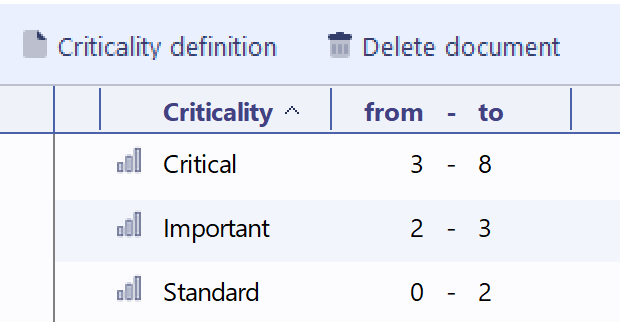
The PRISM IT Systems module provides a central register of organisational information systems, covering ownership, technical architecture, data classification, DORA criticality, and business continuity parameters such as RTO, RPO, and MTPD. It links system data to incident management and testing, supports SLA breach detection, and records third-party ICT providers to facilitate DORA compliance. The module can be used with minimal configuration, with optional questionnaires and test protocols available for more structured assessments and auditability.
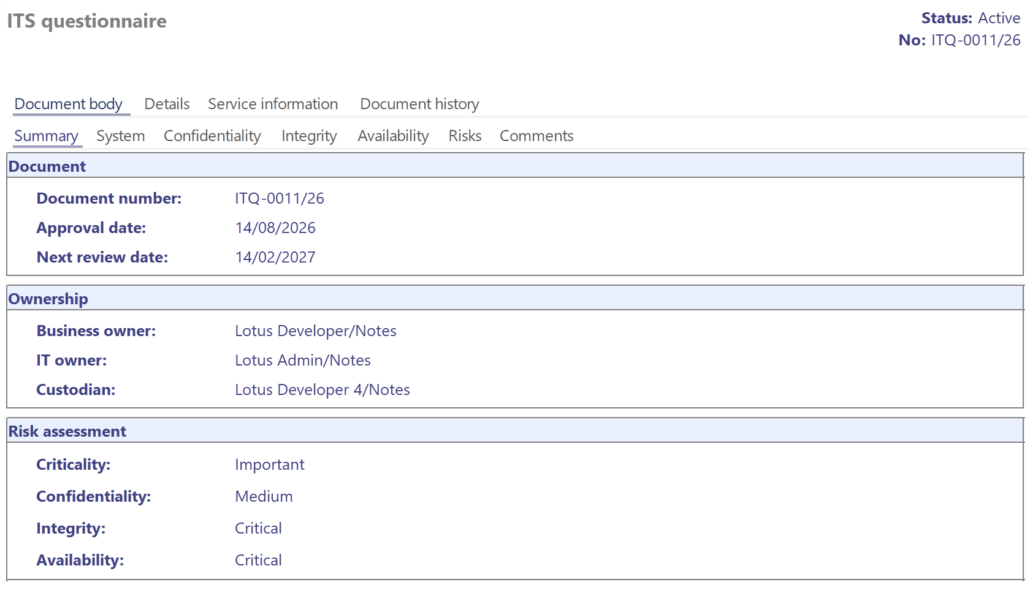
The questionnaire is represented by large set of fields and configurable workflow. Regular reviews of each questionnaire are recorded as a new version of the document.
PRISM assesses Confidentiality, Integrity, and Availability through structured classification questions tailored to each IT system. Responses are automatically mapped to four risk levels — Low, Medium, High, or Critical — using standardised criteria, including data sensitivity and business impact. The GRC team can review and override calculated ratings when justified by the system’s specific context, ensuring consistent and auditable assessments.
The PRISM IT System Questionnaire guides system owners through risk identification, mitigation planning, and the assessment of Confidentiality, Integrity, Availability (CIA), and system criticality. Automated calculations based on standardised classifiers ensure consistent, auditable results, which are reviewed by the GRC team and integrated directly into the system card, keeping the asset register accurate and up to date.
The PRISM IT Systems module provides a central register of organisational information systems, covering ownership, technical architecture, data classification, DORA criticality, and business continuity parameters such as RTO, RPO, and MTPD. It links system data to incident management and testing, supports SLA breach detection, and records third-party ICT providers to facilitate DORA compliance. The module can be used with minimal configuration, with optional questionnaires and test protocols available for more structured assessments and auditability.
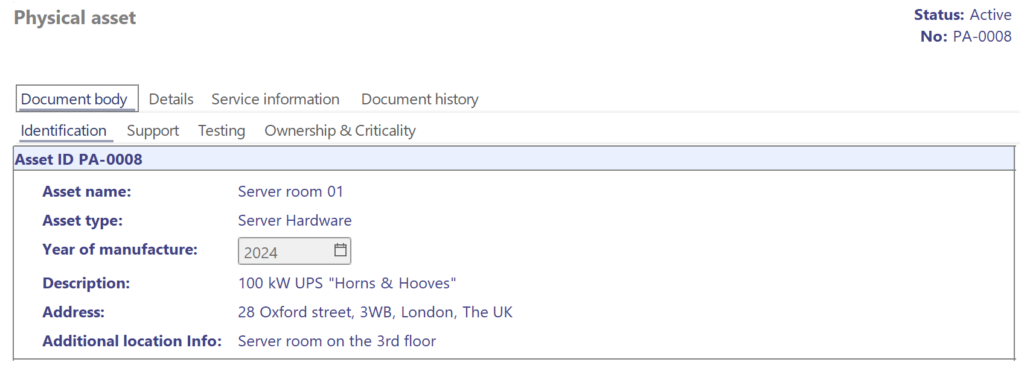
The questionnaire is represented by large set of fields and configurable workflow. Regular reviews of each questionnaire are recorded as a new version of the document.
PRISM assesses Confidentiality, Integrity, and Availability through structured classification questions tailored to each IT system. Responses are automatically mapped to four risk levels — Low, Medium, High, or Critical — using standardised criteria, including data sensitivity and business impact. The GRC team can review and override calculated ratings when justified by the system’s specific context, ensuring consistent and auditable assessments.
The Cyber Incident module gives organisations a structured way to record, investigate, and close ICT-related incidents — from a minor suspicious login to a full-scale ransomware attack. Each incident is linked to the affected IT systems, automatically pulling in their criticality and recovery targets, so the team always knows what is at stake and whether SLA commitments are being met. For Latvian organisations, the module supports the preparation and printing of regulatory notification forms in accordance with Cabinet Regulation No. 397, and tracks DORA reporting deadlines — 4 hours, 72 hours, and one month — directly within the incident record. Once an incident is closed, it can be linked to the relevant risk cards, feeding the lessons learned back into the risk management process.
When registering a cyber incident, the user selects the affected IT systems from the asset register — the system automatically pulls in their criticality level, RTO, RPO, and MTPD targets, which are then used to assess the severity of the incident and detect any SLA breaches without manual data entry. The link to risk cards is established at the closing stage of the incident, when the full picture of the event is clear — the responsible officer reviews the active risk register and assigns the risks that were realised during the incident, triggering an automatic prompt for their reassessment.
The processing process is configured by the system administrator. The default loop is configured for the system. The incidents allow to generate notifications to the regulators and assign identified risks to the incident card.
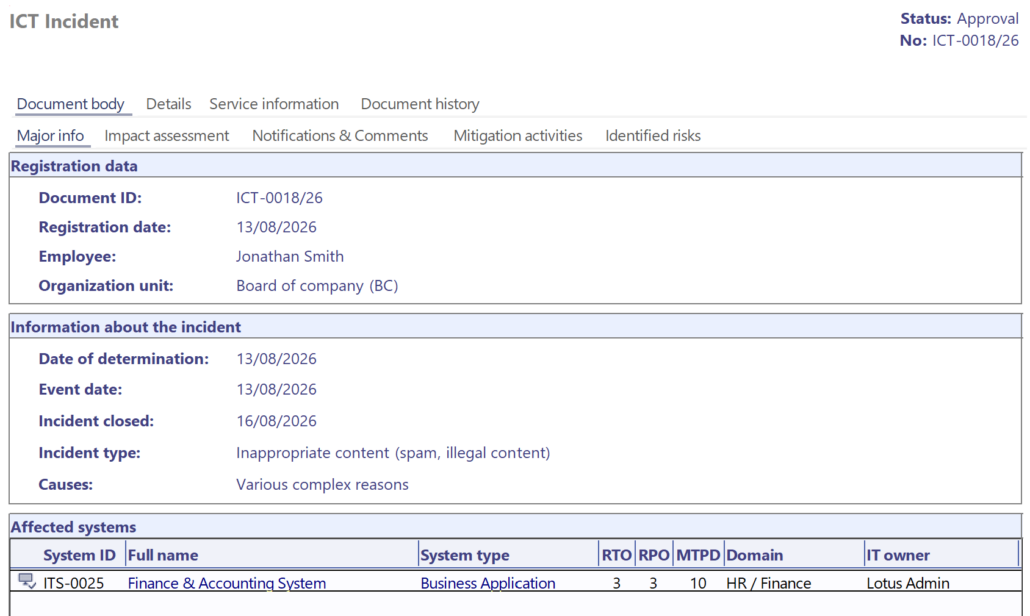
The System can generate the notifications required by local regulators regarding to the incident progress. This is bespoke option, which is not out-of-the-box functionality, and can be delivered as a custom functionality.
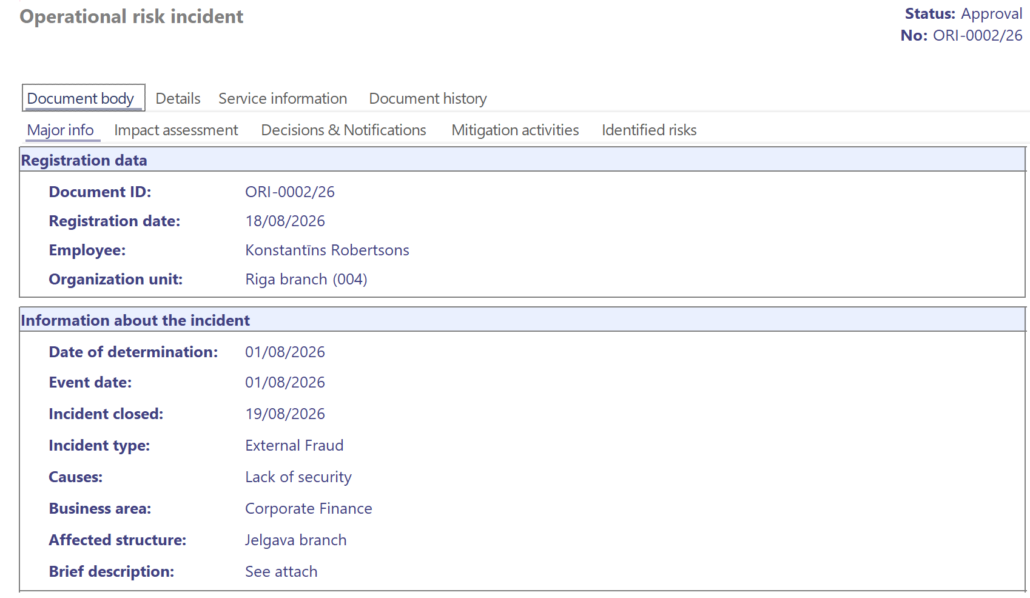
The Operational Risk Incident module is an optional extension that captures risk events falling outside the scope of ICT incidents — such as process failures, human errors, fraud, or vendor-related disruptions — following the same structured lifecycle as the cyber incident register. Each incident is classified according to the Basel III operational risk taxonomy, linked to the relevant risk cards at closure, and routed through a configurable approval workflow that involves security, HR, and management as required by the nature of the event.
When an operational risk incident is closed, the responsible officer reviews the active risk register and manually assigns the risks that were realised during the event — establishing a traceable link between what was anticipated in the risk assessment and what actually occurred.
The processing process is configured by the system administrator. The default loop is configured for the system. The incidents allow to generate notifications to the regulators and assign identified risks to the incident card.
PRISM is integrated with email services. The notification mechanism uses 2 modes:
| Mode | Description |
|---|---|
| After the event | Alerts users when the status of an incident or risk changes. |
| According to the schedule | Control of deadlines |
By default, the following events are supported (events are subject of configuration):
| Notification | Before term | Overdue | Recipient |
|---|---|---|---|
| Supplier agreement is due | 30 days | X | Responsible |
| System review is due | 30 days | X | Business Owner Technical Owner Responsible security officer |
| Test is due | 30 days | X | Business Owner Technical Owner |
| ITS questionnaire is due | 30 days | X | IT owner |

Planned for 2027, PRISM will introduce AI-assisted risk validation to improve assessment consistency, identify methodological errors, and align evaluations with international best practices. AI will support—not replace—expert judgment, with final decisions remaining the responsibility of authorised personnel.
For organisations with strict information security requirements, the planned solution will support a local, on-premises architecture, keeping data processing within the client’s infrastructure and reducing exposure to cloud-related privacy and data transfer risks.
CYONE transforms regulatory documentation into a controlled workflow with document versioning, approval processes, employee acknowledgements, and a complete audit trail. It provides clear visibility into who has reviewed and accepted requirements, which document versions were in force, and whether required actions have been completed.
Integration with PRISM and other corporate systems enables organisations to centralise compliance oversight, improve accountability, reduce human-factor risks, and simplify internal and external audits. Document management and cyber incident tracking can leverage data from both CYONE solutions and third-party IT systems.
This will help your company beat your competitors, while offering employees modern and effective tools for business

Leading HCL & IBM oriented company in Baltic countries and Europe. Highly skilled HCL & IBM professionals with almost 20 year experience with HCL & IBM technologies.
Choose a language
